
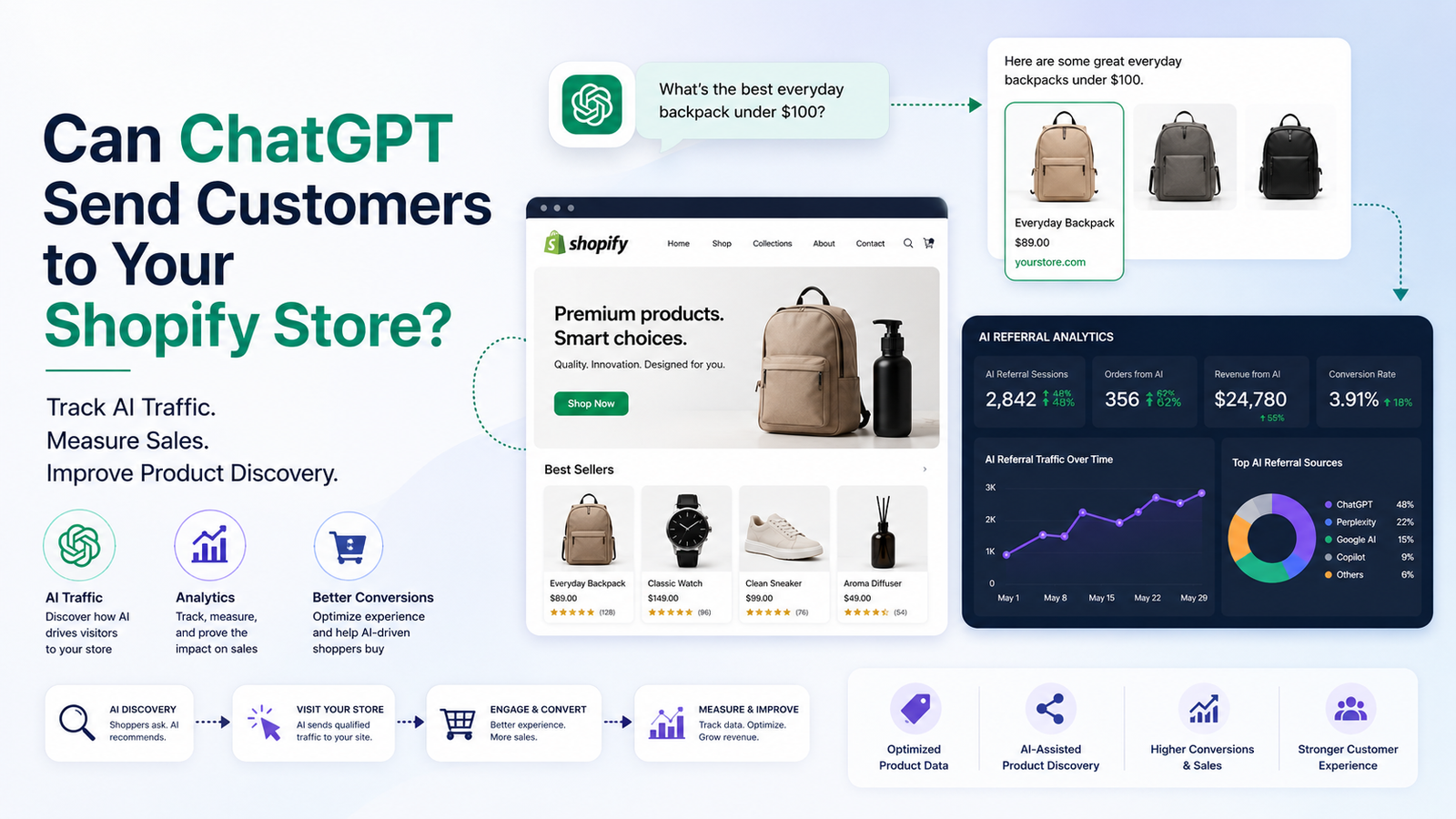
Can ChatGPT Actually Send Customers to Your Shopify Store? And How Do You Measure the Impact?
AI is becoming a new product discovery channel. But visibility alone doesn’t pay the bills. Here’s how Shopify store owners can measure what matters.
Imagine a customer asking ChatGPT:
“What’s the best everyday backpack under $100 that is durable, stylish, and suitable for work?”
Instead of scrolling through pages of search results, the customer receives a shortlist of products that match their needs.
One of those recommendations could be your product.
The customer clicks through to your Shopify store, explores the product page, adds the item to their cart, and completes the purchase.
This is no longer just a hypothetical shopping journey. Shopify’s agentic storefronts enable eligible products to be discovered through AI shopping experiences, including ChatGPT, Google AI Mode, Gemini, and Microsoft Copilot. The exact experience depends on the channel and the store’s eligibility. Shopify’s official guide explains how it works.
But three important questions remain:
- Can ChatGPT actually send customers to your Shopify store?
- How do you know whether AI traffic contributes to conversions and sales?
- Can an AI assistant help customers discover and choose the right products?
Let’s break them down.
1. Can ChatGPT Actually Send Customers to Your Shopify Store?
Yes. ChatGPT can act as a product discovery channel that directs shoppers to online stores.
When shoppers ask for product recommendations, AI systems may surface relevant products based on the request, product information, and the discovery systems available to them.
For eligible Shopify merchants, Shopify Catalog and its agentic storefront infrastructure help make product information available across supported AI shopping channels.
This creates another potential path to your store beyond traditional Google searches, paid advertisements, social media, and email marketing.
However, having a Shopify store does not guarantee that every product will appear in every AI recommendation.
Your product eligibility, the information available about your products, the shopper’s request, and the capabilities of the AI channel can all affect discovery.
What can Shopify store owners do?
Start by reviewing your product information.
- Are your product titles descriptive and accurate?
- Do your descriptions answer real customer questions?
- Are prices, availability, images, and variants correct?
- Are product pages accessible to search engines?
- Is your store eligible for the relevant Shopify AI shopping channels?
- Are your product feeds and structured data accurate where applicable?
Shopify merchants should also review Sales channels → Agentic in their Shopify admin to check available settings and eligibility.
The goal is not to trick an AI system into recommending your products. It is to make your products easy to understand, accurately represented, and available through the appropriate discovery channels.
2. How Do You Track ChatGPT Traffic in Shopify Analytics?
This is where many businesses need a more disciplined approach.
You may hear that AI is changing ecommerce, but you still need to answer a simple business question:
Is AI actually bringing visitors and customers to my store?
The first step is to establish a baseline and monitor identifiable referral traffic.
Step 1: Review your Shopify analytics
Open your Shopify admin and navigate to Analytics.
Review your acquisition and referrer reports to understand where visitors are coming from. Look for identifiable AI-related sources and compare their performance over time.
Shopify’s acquisition reporting includes sessions by referrer, which can help you investigate traffic sources.
Official reference: Shopify acquisition reports.
Step 2: Use Google Analytics 4
If GA4 is installed and configured correctly, review your traffic acquisition reports.
Look for identifiable sources such as ChatGPT-related referral domains and other AI platforms. Depending on how the visitor arrives, the source may appear under a referral medium or another traffic classification.
Don’t assume every AI visit will be clearly identified. Some visits may appear as direct traffic, and tracking limitations can obscure the original source.
Step 3: Monitor more than sessions
Traffic is useful, but it isn’t the final measure of success.
Track the following metrics where the data is available:
- AI-referred sessions: How many visits come from identifiable AI sources?
- Engagement: Do those visitors explore relevant products?
- Add-to-cart rate: Are visitors showing buying intent?
- Conversion rate: What proportion of sessions result in purchases?
- Revenue: How much sales revenue is attributed to those visits?
- Average order value: How much do customers spend per order?
Compare these metrics across consistent reporting periods, and segment the data by landing page and source where possible.
Step 4: Understand attribution limitations
A customer might discover your brand in ChatGPT, return through Google later, and eventually purchase by typing your store’s URL directly into their browser.
Your analytics may attribute the final purchase to a different channel.
For that reason, AI referral traffic is not the same as AI’s total influence on purchasing decisions.
Use referral data alongside other evidence, such as customer surveys, branded search trends, and changes in conversion behavior. Avoid claiming that AI generated a sale unless the available evidence supports that conclusion.
3. How Do You Know Whether AI Is Improving Your Conversion Rate?
Let’s say your Shopify store receives 10,000 sessions in a month, and 200 result in purchases.
Your conversion rate is:
200 ÷ 10,000 × 100 = 2%
Now imagine your store begins receiving traffic from AI shopping recommendations.
To determine whether this channel performs well, compare the conversion rate of identifiable AI-referred sessions with that of other traffic sources.
For example, if AI-referred visitors convert at a higher rate than visitors from a particular paid campaign, that may indicate an opportunity worth investigating.
But be careful.
A higher conversion rate does not automatically prove that AI caused the improvement. The difference could be influenced by product selection, customer intent, promotions, seasonality, or sample size.
What should a conversion audit examine?
Traffic quality: Are AI visitors arriving on relevant product pages?
Product relevance: Do the recommended products match what customers expect?
Landing-page experience: Can visitors quickly understand the product’s value?
Trust signals: Are reviews, delivery details, returns policies, and contact information easy to find?
Checkout experience: Are there unnecessary steps or unexpected costs?
Tracking quality: Are sessions, purchases, and revenue being recorded consistently?
A useful audit connects the entire journey: discovery, landing page, product evaluation, cart, checkout, and completed purchase.
That is how you move beyond counting AI clicks and start evaluating commercial impact.
4. Can an AI Assistant Help Customers Choose Products?
Absolutely. An AI assistant can help shoppers narrow down their options by interpreting questions expressed in everyday language.
Imagine a visitor on your store asking:
“I need a water bottle for the gym that holds at least two litres, doesn’t leak, and is easy to carry.”
A useful shopping assistant could identify relevant products, compare capacities, explain differences, and direct the customer to suitable options.
This can make product discovery more intuitive than requiring visitors to understand your exact product names or navigate several filters.
Shopify also offers tools that support conversational product discovery and AI-assisted customer interactions, depending on the features and setup available to the merchant.
However, the assistant is only as useful as the information it can access.
If product specifications are incomplete, variants are confusing, or inventory information is inaccurate, recommendations may be less relevant or misleading.
How to improve AI-assisted product discovery
1. Organize your catalogue. Use consistent product categories, variants, and attributes.
2. Write useful product descriptions. Include specifications, use cases, compatibility, dimensions, materials, and other decision-making details.
3. Make comparisons easy. Clearly explain what differentiates similar products.
4. Keep product data accurate. Review prices, availability, shipping information, and returns policies.
5. Test real customer questions. Ask questions shoppers would genuinely use, then check whether the correct products appear.
6. Measure the results. Where tracking allows, compare product engagement, add-to-cart activity, and conversions before and after changes.
AI should help customers make informed choices, not pressure them into buying unsuitable products.
5. A Practical 7-Day Action Plan for Shopify Store Owners
You don’t need to overhaul your entire ecommerce operation to begin.
Here is a simple starting point.
Day 1 — Check your AI shopping eligibility. Review Shopify’s available agentic storefront settings and product eligibility.
Day 2 — Audit your product catalogue. Identify incomplete titles, descriptions, attributes, variants, and images.
Day 3 — Review technical SEO. Check crawlability, indexing, structured data, and important product-page issues.
Day 4 — Inspect your analytics. Verify Shopify acquisition reports, GA4 traffic sources, ecommerce events, and purchase tracking.
Day 5 — Review your product pages. Improve product clarity, delivery information, reviews, and calls to action.
Day 6 — Test product discovery. Try realistic shopping questions and evaluate whether your catalogue answers them accurately.
Day 7 — Establish a baseline. Record identifiable AI-referred sessions, conversion metrics, and revenue where available, then continue monitoring trends.
The objective is to create a measurable starting point instead of relying on assumptions about what AI might be doing for your business.
The Bigger Opportunity: Make Your Shopify Store Easier to Discover, Understand, and Buy From
AI-driven shopping is creating new possibilities for ecommerce businesses, but it doesn’t eliminate the fundamentals of good marketing.
Your products still need accurate information. Your website still needs to build trust. Your checkout still needs to work smoothly. And your analytics still need to tell you what is happening.
The stores best positioned to benefit are those that combine discoverability with a useful shopping experience and a clear measurement strategy.
At 7DaysExpert, we help Shopify businesses improve their stores through ecommerce SEO, conversion rate optimization, product-page improvements, marketing analytics, and strategic store development.
If you’re unsure whether your Shopify store is ready for AI-assisted product discovery or whether your current marketing is turning traffic into sales, the first step is to identify the gaps.
Visit https://7DaysExpert.com to discuss your Shopify store and the improvements that could make the biggest difference.
The question is no longer simply whether AI can help customers discover your products.
It’s whether your store is ready when those customers arrive.
#Shopify #Ecommerce #AIShopping #ShopifyMarketing #ConversionRateOptimization #DigitalMarketing
