
AI is changing how people discover products online. Is your Shopify store ready to be found?
Imagine a customer asking ChatGPT, Google, or another AI-powered shopping assistant:
“What’s the best skincare product for sensitive skin under $50?”
Instead of browsing dozens of websites, the customer may receive a shortlist of products, comparisons, recommendations, and links to stores where they can buy.
Now, here’s the important question for Shopify store owners:
Will your products be among the recommendations, or will your competitors get the attention?
AI-driven shopping is creating new opportunities for ecommerce businesses. But being online is no longer the only thing that matters. Your store also needs to communicate its product information clearly, maintain reliable data, and make it easier for search engines and AI-powered discovery tools to understand what you sell.
At 7DaysExpert, we believe preparing your Shopify store for this shift starts with getting the fundamentals right.
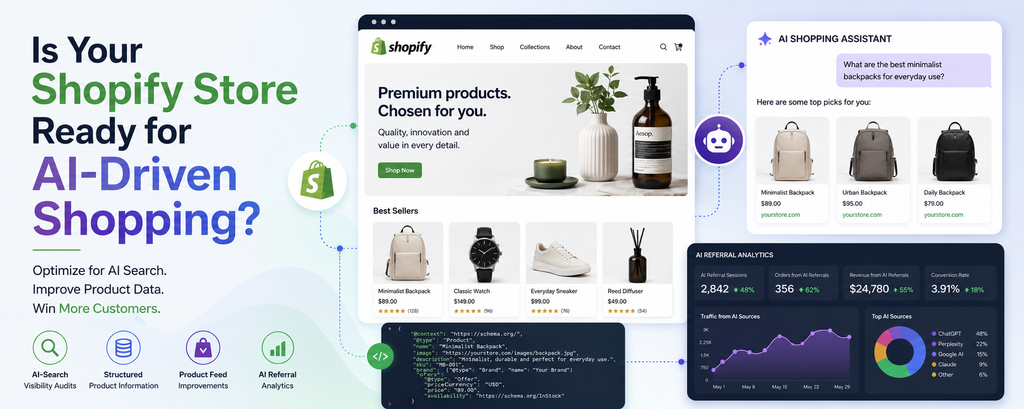
1. AI Search Visibility: Can AI Understand and Recommend Your Products?
Traditional SEO focuses on helping your website appear in search engine results. AI-driven discovery introduces additional ways customers may find products, including conversational answers, product comparisons, and shopping recommendations.
However, there is no guaranteed way to make an AI assistant recommend your store.
What you can do is improve the information and signals that help discovery systems understand your products.
This includes:
- Writing clear, descriptive product titles.
- Creating original product descriptions that answer real customer questions.
- Optimizing collection pages around customer needs and product categories.
- Making important product information accessible to search crawlers.
- Building trustworthy brand information and relevant external references.
- Checking how your products appear in traditional search and AI-powered discovery experiences.
The goal isn’t to write content simply to please AI. It is to make your store genuinely useful to both shoppers and the systems helping them discover products.
2. Structured Product Information: Give Your Products a Clear Identity
One common ecommerce problem is incomplete or inconsistent product information.
A product page might look attractive to a human visitor but still leave important questions unanswered.
What are its dimensions? What materials is it made from? Which sizes are available? What makes it different from competing products? Is it suitable for a particular use?
Structured product information helps make these details clearer.
For Shopify stores, this can include:
- Accurate product titles and descriptions.
- Consistent product variants, sizes, colors, and specifications.
- Product structured data, including appropriate Schema.org markup.
- Correct price, availability, and product identifiers.
- Clear shipping, returns, and business policies.
- Consistent information between product pages and product feeds.
When product information is accurate, search engines and compatible shopping systems have a stronger foundation for interpreting your catalogue.
Remember: structured data helps machines understand your products, but it does not guarantee rankings or AI recommendations.
Accuracy and consistency matter more than adding technical markup without a clear purpose.
3. Product Feed Optimization: Don’t Let Poor Data Hide Your Best Products
Your product feed is an important part of ecommerce discovery.
Depending on the channels you use, product feeds can supply information to Google Merchant Center, advertising platforms, marketplaces, and other shopping services.
If your feed contains missing attributes, incorrect prices, outdated availability, or inconsistent product identifiers, you may lose valuable opportunities for product visibility.
A Shopify product-feed audit should examine:
Product titles: Do they describe the product accurately and use language customers understand?
Descriptions: Do they communicate the product’s benefits, features, and intended use?
Images: Are they clear, relevant, and compliant with the destination platform’s requirements?
Availability and pricing: Do they match the current information on your Shopify store?
Product identifiers: Are brand, GTIN, MPN, and other applicable identifiers supplied correctly?
Variants: Are sizes, colors, and other options represented consistently?
Category and attributes: Are products classified correctly with relevant attributes?
Improving your product feed can help eligible products qualify for and perform better across supported shopping channels. It is not a shortcut to guaranteed AI visibility, but it is an important part of a reliable ecommerce foundation.
4. AI Referral Analytics: Are AI Tools Actually Sending You Customers?
There is a difference between appearing in an AI-generated answer and receiving measurable business results.
Your store could receive AI-referred visitors without generating purchases. Alternatively, some AI-assisted discoveries may influence a customer’s decision before they eventually visit your website through another channel.
That is why measurement matters.
Start by reviewing:
- Referral traffic from identifiable AI-related sources.
- Landing pages receiving those visits.
- Engagement and conversion rates from AI-referred sessions.
- Add-to-cart activity and completed purchases.
- Revenue and average order value where attribution is available.
- Changes in branded search and direct traffic over time.
Use Shopify analytics alongside your analytics platform, such as Google Analytics 4, and review referral and campaign attribution where available.
Keep in mind that attribution is imperfect. Some AI interactions are not visible in your analytics, and a referral source does not necessarily prove that AI was the original influence behind a purchase.
The objective is to build a clearer picture of how customers discover your brand and which channels contribute to sales.
5. Your Shopify Store Readiness Checklist
Before investing heavily in new AI tools, assess whether your store has the fundamentals in place.
☐ Product titles and descriptions are complete and accurate.
☐ Product prices, availability, and variants are consistent.
☐ Product structured data is implemented correctly where appropriate.
☐ Important product and collection pages can be crawled and indexed.
☐ Product feeds are connected and free of significant data errors.
☐ Shipping, returns, contact information, and brand details are easy to find.
☐ Your store provides a good mobile shopping experience.
☐ Analytics and conversion tracking are configured correctly.
☐ AI-related referral traffic is monitored where identifiable.
☐ Product content answers the questions customers actually ask.
If several of these areas need attention, you may have foundational issues worth resolving before investing in more advanced AI-discovery strategies.
6. What Shopify Store Owners Should Do Next
You do not need to rebuild your entire store to prepare for AI-driven shopping.
Start with an audit.
Identify missing product information, resolve feed errors, improve important product pages, verify your technical SEO, and establish a baseline for referral traffic and conversions.
Then prioritize improvements according to their likely impact on customers and business performance.
For some stores, the biggest opportunity will be product-feed quality. For others, it may be technical SEO, weak product descriptions, poor conversion rates, or missing analytics.
The right strategy depends on your current store, your product category, your target market, and the channels your customers use.
AI-driven shopping is still evolving, so avoid anyone promising guaranteed placement in ChatGPT or other AI recommendations.
Focus instead on building a store that is understandable, trustworthy, technically sound, and easy for customers to buy from.
Is Your Shopify Store Ready for the Next Phase of Ecommerce?
At 7DaysExpert, we help businesses improve their Shopify stores through website optimization, ecommerce SEO, conversion rate optimization, product information improvements, and marketing analytics.
If you’re unsure whether your store is prepared for AI-driven product discovery, we can help you identify gaps and prioritize practical improvements.
Send us a message or visit https://7DaysExpert.com to discuss your Shopify store.
The future of ecommerce isn’t just about getting more traffic. It’s about helping the right customers discover the right products and giving them a clear reason to buy.
#Shopify #Ecommerce #AIShopping #ShopifySEO #DigitalMarketing
